For many years, bands recorded their music live in the same room, capturing the raw energy of their performance in real time. With the evolution of digital technology and signal processing, studios gained the flexibility to either isolate musicians while recording simultaneously or track each instrument asynchronously. This shift sparked a long-standing debate in the audio engineering world: What’s the best way to record a band?
- Live Recording in the Same Room – All musicians play together in a shared space, creating a natural, live-show feel but introducing the challenge of sound leakage. (Leakage refers to the unintended spillover of sound from one instrument into another’s microphone, potentially complicating the mixing process.)
- Isolated Multi-Tracking – Each instrument is recorded separately, starting with drums, followed by guitars, bass, and vocals. This method offers more control over the final mix but may sacrifice some of the live energy and band chemistry.
Both approaches have their merits, but I want to focus on the role of the recording engineer in these setups—particularly the physical and psychological barrier created by the control room glass.
Howard Massey’s book “Behind the Glass: Top Record Producers Tell How They Craft the Hits” inspired a thought: Why is the engineer always behind the glass? What if we removed it entirely?
My Journey: Breaking the Glass Barrier
When I started as an audio engineer during my early university years, I was fortunate to work in my mentor’s studio. It had a traditional setup—separate live and control rooms divided by a window. Communication relied on a talkback microphone and headphone system, but visual interaction was limited. Most of my sightline was toward the drummer, leaving the rest of the band somewhat disconnected.
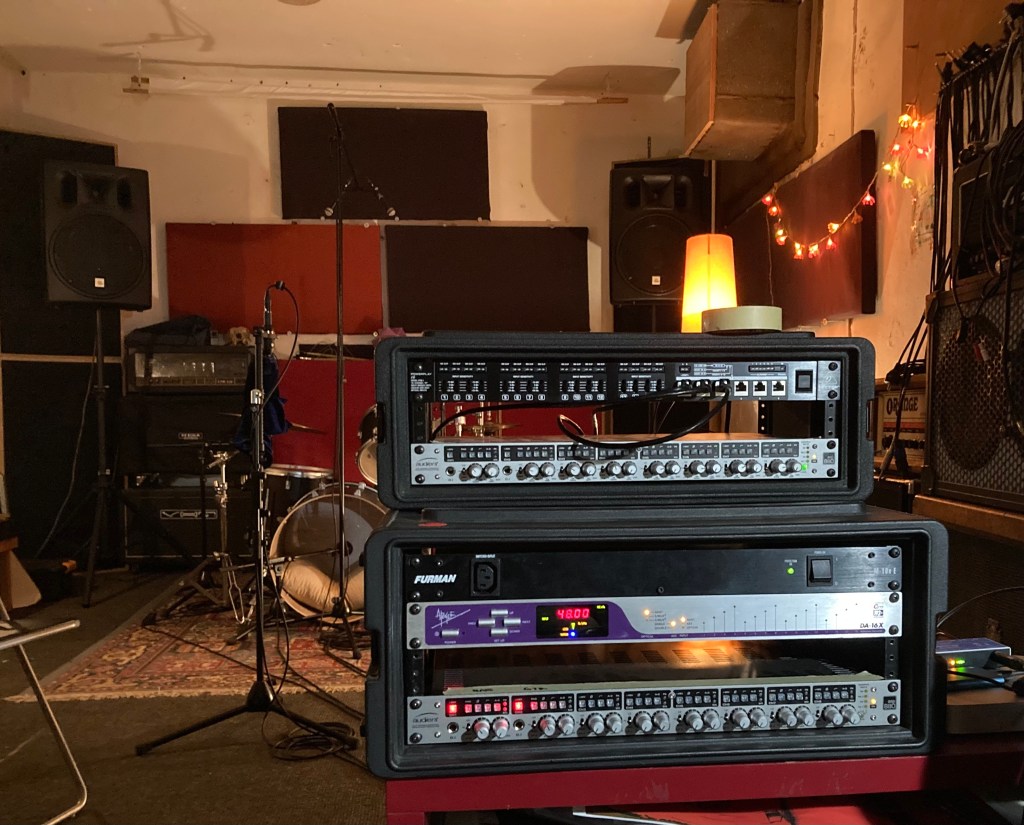
Years later, I transitioned to a new studio where everything was in a single open space. There were no separate rooms—drums, amps, and microphones all in the same space. Suddenly, I wasn’t behind the glass anymore; I was in the room with the band. This radically changed my mindset and workflow, requiring new methods for monitoring, recording, and even thinking about production.
Adapting to the New Environment
Monitoring Setup
Since speakers were no longer an option for monitoring during sessions, I needed high-quality closed-back headphones for accurate listening and isolation. The entire band also had to use the same model of headphones, converters, and headphone preamps to maintain consistency—similar to how control-room monitors serve as a shared reference.
Managing Instrument Leakage
To minimize bleed between instruments, I integrated speaker load boxes with Cabinet Impulse Responses (IRs) for the guitar and bass amps. This allowed the musicians to hear a natural amp sound while tracking quietly. After recording, I could reamp the signals at a later stage for optimal tone.
The Pros of a Shared Recording Space
From an engineer’s perspective, being in the same room with the band had significant advantages:
- The process felt more like a live show, making the experience more enjoyable and dynamic.
- I could instantly recognize issues like mistakes, timing inconsistencies, and tuning problems in real time.
- Hearing full-band performances rather than isolated instrument takes provided a clearer creative vision.
- Communication was immediate—when I had an idea, I could share it with the band instantly.
- Musicians often delivered stronger performances, possibly because my presence added a subtle layer of ‘audience pressure.’
The Challenges of a Shared Recording Space
Of course, this approach also came with notable drawbacks:
- Sound exposure – Being in the same room with loud instruments for extended periods was both fatiguing and potentially damaging to my hearing. Frequent breaks were necessary, but they could interrupt the creative flow.
- Headphone leakage and extraneous noise – Low-volume sections of songs made it crucial to control background sounds like mouse clicks or movement in the room.
- Temperature control – Musicians often need a warm environment to perform comfortably, whereas I thrive in cooler conditions. Finding a balance was sometimes a challenge. (just kidding…)
Returning to the Glass
After years of working in an open recording space, I recently moved to a new city and a new studio—one with a traditional control room setup. And just like that, the glass was back.
While my monitoring setup is now ideal, something feels off. The return my monitor speakers and an isolated control room is great, but the disconnection from the artists is undeniable. Pressing the talkback button again felt strange. Watching musicians through a window instead of being in the same space reminded me of the barriers that originally led me to embrace open-room recording.
Where Do I Go from Here?
Reconstructing the studio to remove the separation isn’t feasible at the moment. My focus has shifted more toward production and mixing, making a controlled acoustic environment essential, too. However, I keep wondering about the most optimal solution—would a larger window help? What if I replaced the entire front wall with glass? Maybe even experiment with a sliding door that could stay open for certain sessions to maintain a level of direct interaction? Many thoughts, and exploring the possibilities might just lead me to the right answer.
Until I figure it out, it’s back to mixing.
(‘Little Grave’ by Chelsea Wolfe was playing in the background.)
 Chapter V Audio